 +65 8899 1048
 products@spedsg.com
Loading cart contents...
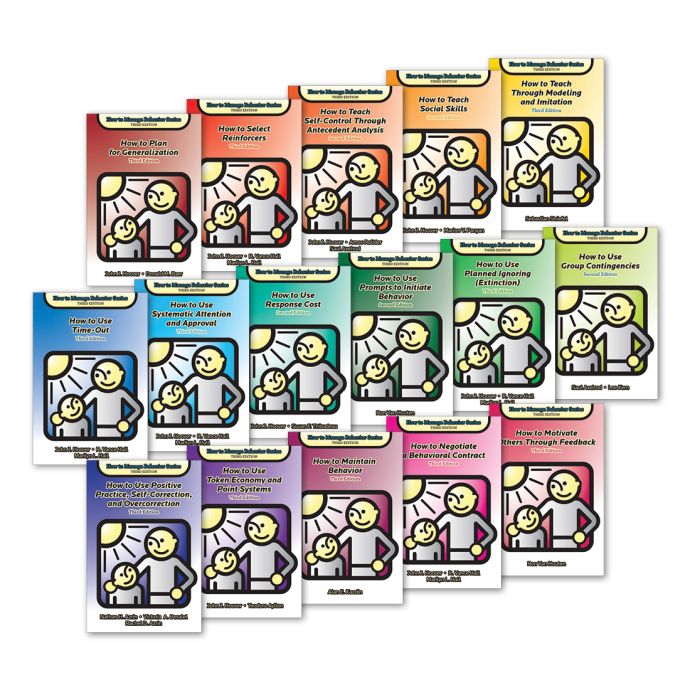
How to Manage Behavior Series, 3Ed.
Complete Set of 16 Books
The revision of this series is highly timely and contemporary. The need for effective behaviour management in children, youth, and adults is as important as ever given various events in today’s society such as the increases in the numbers of children identified with autism, of bullying incidences both cyber and physical, and of school and workplace violence.
The How To Manage Behavior Series, 3Ed. contains 16 newly revised titles for practitioners and parents.
Authors : John J. Hoover, Marilyn L. Hall, R. Vance Hall, Ron Van Houten, Saul Axelrod, Alan E. Kazdin, Amos Rolider, Donald M. Baer, Lee Kern, Marion V. Panyan, Nathan H. Azrin, Rachel D. Azrin, Sebastian Striefel, Susan F. Thibadeau, Teodoro Ayllon & Victoria A. Besalel
Description
The How To Manage Behavior Series, 3Ed. contains 16 newly revised titles for practitioners and parents. These texts include effective, research-based strategies for use in increasing appropriate behaviours of children, students, and other persons whose behaviour may be lacking or be creating problems at home, at school, or on the job. The books are nontechnical, step-by-step instructional manuals that define the procedures, provide numerous examples, and allow the reader to make oral or written responses.
The series includes:
- How to Maintain Behavior
- How to Motivate Others Through Feedback
- How to Negotiate a Behavioral Contract
- How to Plan for Generalization
- How to Select Reinforcers
- How to Teach Self-Control Through Antecedent Analysis
- How to Teach Social Skills
- How to Teach Through Modeling and Imitation
- How to Use Group Contingencies
- How to Use Planned Ignoring (Extinction)
- How to Use Positive Practice, Self-Correction, and Overcorrection
- How to Use Response Cost
- How to Use Prompts to Initiate Behavior
- How to Use Systematic Attention and Approval
- How to Use Time-Out
- How to Use Token Economy and Point Systems
1. How to Maintain Behavior (by Alan E. Kazdin) – Addresses how to maintain behaviour after a behaviour-change programme is withdrawn. Several techniques have been devised to develop desired behaviours and eliminate undesired behaviours among children and adults. Techniques such as systematic attention and praise, planned ignoring, feedback, modelling positive practice, and others are described in other books in this series.
This book presents several methods that can be used alone or in combination to maintain behaviour. The techniques are implemented after behaviour changes have been achieved and before the programme is completely withdrawn. The manual presents different techniques to maintain behaviour and illustrates their applications with different clients, behaviours, and settings. Exercises are provided to help you develop skill in applying the different procedures and troubleshooting.
2. How to Motivate Others Through Feedback (by Ron Van Houten) – Recent research has documented that teachers, parents, coaches, managers, and administrators can more effectively motivate others when they systematically employ performance feedback.
To use feedback effectively, one needs to understand and apply the principles that govern the successful application of this powerful motivational tool. This book is designed to teach you how to use feedback as an effective means of prompting and strengthening productive behaviours. Exercises included in the book provide an opportunity for you to begin practicing the use of feedback almost immediately.
3. How to Negotiate a Behavioral Contract (by John J. Hoover, R. Vance Hall & Marilyn L. Hall) – For parents, teachers, childcare workers, counsellors, employers, and others who may want to negotiate behavioural contracts. It is designed for use under the supervision of a counsellor or other professional person familiar with behavioural contracts. This many include an instructor or colleague. The format enables the instructor or colleague to review the fill-in information provided by the reader, and to use that feedback to assure the reader’s proper understanding, development, and use of behavioural contracts.
Whether knowingly or unknowingly, we use some kind of formal or informal behavioural contracting each day, along with some form of negotiation in our interactions with other persons. With this booklet, the time for trial and error and hoping for the best when using contracting as an effective behaviour change technique is past. Using properly negotiated contracts, two or more individuals are provided a say and an opportunity to suggest alternate behaviours or rewards, thereby facilitating ownership leading to greater behaviour change successes. If the behaviour contract negotiation is carried out in good faith, individuals feel positive about signing the contract, understand its features and expectations, know that it is fair, and have an interest in seeing that it brings about the desired changes in the behaviours of everyone involved.
Changing someone else’s behaviour is often a necessary and difficult task, which can only be accomplished when people negotiate in good faith and are willing to give up something in return. This includes interactions between various individuals such as parents with children, teachers with students, friends with friends, coworker with coworker, or employer with employee, to name a few. Users of this book will learn how to negotiate and draw up a behavioural contract for use in the home, school, or workplace by ensuring that (a) the behaviours to change are clearly defined and agreed upon; (b) the rewards for the behaviour change, including how the rewards will be delivered, are clearly spelled out; (c) the contract benefits everyone involved; and (d) once a developed and signed document, there is no misunderstanding about its contents, delivery, and outcome.
4. How to Plan for Generalization (by John J. Hoover & Donald M. Baer) – Written for persons who have the task of bringing about deliberate behaviour changes in themselves or others. Personal behaviour change to achieve goals may occur in many areas of one’s life, such as exercise, life-long learning, weight, socialisation, or anger management, to name a few. Generalising that behaviour change is key to long-term success of behaviour management. Through the use of examples, tasks, and step-by-step procedures, this book explores the tools to help learn behaviour management strategies and to use these strategies to achieve generalisation.
5. How to Select Reinforcers (by John J. Hoover, R. Vance Hall & Marilyn L. Hall) – Teachers, employers, parents, and trainers in a variety of educational, community, and workplace settings will find this book helpful, since selecting and using appropriate reinforcers is a basic step toward addressing many behavioural, performance, and educational challenges. The book includes sections on Classifying Reinforcers, the 9 Steps to Selecting Potential Reinforcers, and a helpful list of Potential Reinforcers for a variety of age groups.
6. How to Teach Self-Control Through Antecedent Analysis (by John J. Hoover, Amos Rolider & Saul Axelrod) – Events that directly precede and serve as a “trigger” for a problem behaviour are called antecedents. The focus of this book is identifying and addressing antecedents to reduce inappropriate behaviour and improve self-control. Though our discussions emphasise the antecedent behaviour of children in school environments, readers should find it easy to extend the principles and procedures of antecedent analysis to behaviours seen in home, recreational, and work environments. Practical vignettes and authentic tasks containing pertinent questions aid in the systematic study of understanding and controlling antecedents. Five useful appendixes are included.
7. How to Teach Social Skills (by John J. Hoover & Marion V. Panyan) – Introduces successful social skills training methods and programmes so that readers may improve their teaching, counselling, mentoring, or parenting skills. Such improvements may result in individuals having more socially appropriate skills today, as well as passing positive social skills on to the next generation. A step-by-step process for social skills development and four useful appendixes for documenting behaviour and skills are included. This book provides readers with a clear blueprint for instilling this necessary skill set for those in need of behaviour management to effectively function in the home, school, and community.
8. How to Teach Through Modeling and Imitation (by Sebastian Striefel) – Describes the process for teaching individuals of all ages to imitate a diversity of models and behaviours. Parents, teachers, and others who want to teach or learn by using modelling and imitation will find this book a helpful tool. It includes information, procedures, examples, exercises, and tasks to simplify the understanding of modelling and imitation and to help the user learn how to teach with these techniques. Separate sections address modelling and imitation as they occur in the natural environment, and with young children, teenagers, and adults.
9. How to Use Group Contingencies (by Saul Axelrod & Lee Kern) – Discusses using group contingencies to benefit particular situations as compared with individual contingencies. Three different applications of group contingencies are described and illustrated with examples. Advantages and disadvantages are noted to identify benefits and common pitfalls of group contingencies. Additional considerations help practitioners gauge the appropriateness of group contingencies and plan for implementation that will offer optimal benefits in their own situations. Detailed examples of research-validated group contingencies are included, spanning a variety of contexts and settings, illustrating the many uses of group contingencies. Included is a step-by-step guide to implementing group contingencies.
10. How to Use Planned Ignoring (Extinction) (by John J. Hoover, R. Vance Hall & Marilyn L. Hall) – Explores the strategies of planned ignoring to help achieve effective behaviour management in your practice, home, school, or community/institution.
This book describes the process for using planned ignoring with individuals of all ages. Parents, teachers, and others will find this book a helpful tool. It includes information, exercises to demonstrate the effects of planned ignoring, basic steps used in planned ignoring, a discussion of when it is inappropriate to used planned ignoring, and a useful appendix for recording the presence of a behaviour.
11. How to Use Positive Practice, Self-Correction, and Overcorrection (by Nathan H. Azrin, Victoria A. Besalel & Rachel D. Azrin) – Explains effective behaviour management techniques for students with developmental disabilities, intellectual disability, and/or emotional disorders.
Positive practice is the systematic, repeated practice of a corrected behaviour in order to interrupt an undesirable behaviour and replace it with a desired behaviour. Self-correction and overcorrection require the student to correct his/her behaviour and then overcorrect as a sort of compensation to the person(s) affected by the negative behaviour. These practices replace any need for punishment or guilt on the part of the student.
Exercises and illustrations included show the use of these procedures. Bibliographic and further-reading references are included.
12. How to Use Response Cost (by John J. Hoover & Susan F. Thibadeau) – intended as a guide for parents, teachers, and other professionals as they work to shape and improve the behaviour of children, students, or other individuals. In this book readers will learn the sequence of steps to follow to use response cost in an effective, ethical, and responsible manner. The examples provided are culled from the body of research in applied behaviour analysis and educator experiences. Tasks are placed throughout the book to guide readers in understanding and applying response cost in home, work, or community environments.
13. How to Use Prompts to Initiate Behavior (by Ron Van Houten) – The first step in promoting new behaviour is getting the behaviour to occur so that it can be reinforced with praise, feedback, or other things the person values. One important way to initiate new behaviour is to prompt it. Behavioural research has documented ways of making prompts work better at guiding behaviour that teachers, parents, coaches, managers, and administrators want to promote. Of course, once the behaviour occurs, it is necessary to reinforce or select it so that it continues to occur in the absence of prompts. If a prompt is well crafted, it can establish the behaviour very quickly and easily. This book presents a programme designed to help instructors and students to become more skillful in using this powerful instructional tool.
14. How to Use Systematic Attention and Approval (by John J. Hoover, R. Vance Hall & Marilyn L. Hall) – presents a programme to help parents, educators, employers, and other community members become skillful in using the powerful and effective motivational tool of systematic attention and approval. It will help readers to understand and use attention and approval more effectively to bring about desirable behaviour in those with whom they live and work. The techniques presented are based on years of fundamental and functional research conducted in real-life settings. Much of the material in this book is based on research conducted by and with parents, teachers, employers, and others whose primary interests were in learning about the importance of approval, acceptance, and attention in behaviour management.
15. How to Use Time-Out (by John J Hoover, R. Vance Hall & Marilyn L. Hall) – Structuring a home or classroom situation to temporarily remove positive reinforcement to reduce undesirable behaviour is referred to as “time-out” in behaviour management. This book includes research to support important features about time-out regarding both positive and negative implications of its use. This text defines and clarifies the concept of time-out and describes in detail the 13 basic steps in using time-out. Exercises, examples, and tasks with a useful appendix for behaviour recording assist the reader. Though the technique is most appropriate for children, this book includes some examples for use with teenagers and with business applications to demonstrate how the principles generalise to other settings and behaviours. The material in this resource provides readers with a solid foundation in the use of time-out.
16. How to Use Token Economy and Point Systems (by John J. Hoover & Teodoro Ayllon) – Describes the use of token and point systems so that practitioners and parents in homes, classrooms, and communities can quickly grasp their essential elements for immediate use to meet the needs of individuals in their own environments. The techniques in this book help to develop a bridge between the desired behaviour and tangible recognition; techniques are based on years of research and experience in real-life settings by many educators overtime. Through examples, and tasks, and easy to follow guidelines, this book explores the tools to help learn about token economies and point systems.
Additional information
| Author | Alan E. Kazdin, Amos Rolider, Donald M. Baer, John J. Hoover, Lee Kern, Marilyn L. Hall, Marion V. Panyan, Nathan H. Azrin, R. Vance Hall, Rachel D. Azrin, Ron Van Houten, Saul Axelrod, Sebastian Striefel, Susan F. Thibadeau, Teodoro Ayllon, Victoria A. Besalel |
|---|---|
| Format | Paperback |
| Pages | 792 |
Reviews
There are no reviews yet.